Short answer: the red maple (momiji) season moves from north to south: Hokkaido in late September and October, the mountains and lakes around Mount Fuji in November, Tokyo and Kyoto from late November to mid-December. The 2026 forecast puts the peak in Tokyo around November 29 and in Kyoto around December 11 — later than usual because of the hot autumn. The best strategy: start in the mountains and finish in the cities.
Everyone knows about the cherry blossoms, but the Japanese look forward to autumn just as much. The leaves only hold their colour for a few weeks, so hitting the peak matters more than picking the "right" city.
What momiji and kōyō mean
Kōyō refers to autumn leaf colour in general, while momiji usually means the red Japanese maples. Alongside them the ginkgo trees turn yellow — the symbol of Tokyo. The tradition of going out to look at the leaves (momijigari) goes back to the aristocrats of Kyoto in the Heian period.
The 2026 forecast
The forecast is published by the Japan Meteorological Corporation and updated through the autumn. According to the September 2 release, the heat means the leaves will turn a little later than usual everywhere (nippon.com).
| City | Red maples, peak | Yellow ginkgo, peak |
|---|---|---|
| Tokyo | around November 29 | around November 26 |
| Kyoto | around December 11 | around November 27 |
| Osaka | around December 4 | around November 24 |
Source: Japan Meteorological Corporation forecast of September 2, 2026 (Time Out Tokyo). Before you travel, check the latest release on tenki.jp or the JMC site: the dates can shift by a week in either direction.
In the mountains everything happens earlier. On Mount Takao near Tokyo (599 m) the peak falls around November 6–20 (nippon.com).
When and where to go, region by region
| Region | Usual peak | What to see |
|---|---|---|
| Hokkaido | late September–October | Daisetsuzan National Park, Shiretoko |
| Tohoku | October | Lake Towada, Oirase Stream |
| Nikko | October–mid-November | Lake Chuzenji, the Irohazaka switchbacks |
| Hakone | late October–late November | Gora Park, Lake Ashi, Sengokuhara |
| The Fuji Five Lakes | late October–late November | The maple corridor at Kawaguchiko, Chureito Pagoda |
| Tokyo | late November–early December | The Icho Namiki ginkgo avenue, Rikugien garden |
| Kamakura | late November–early December | Temples in the wooded hills |
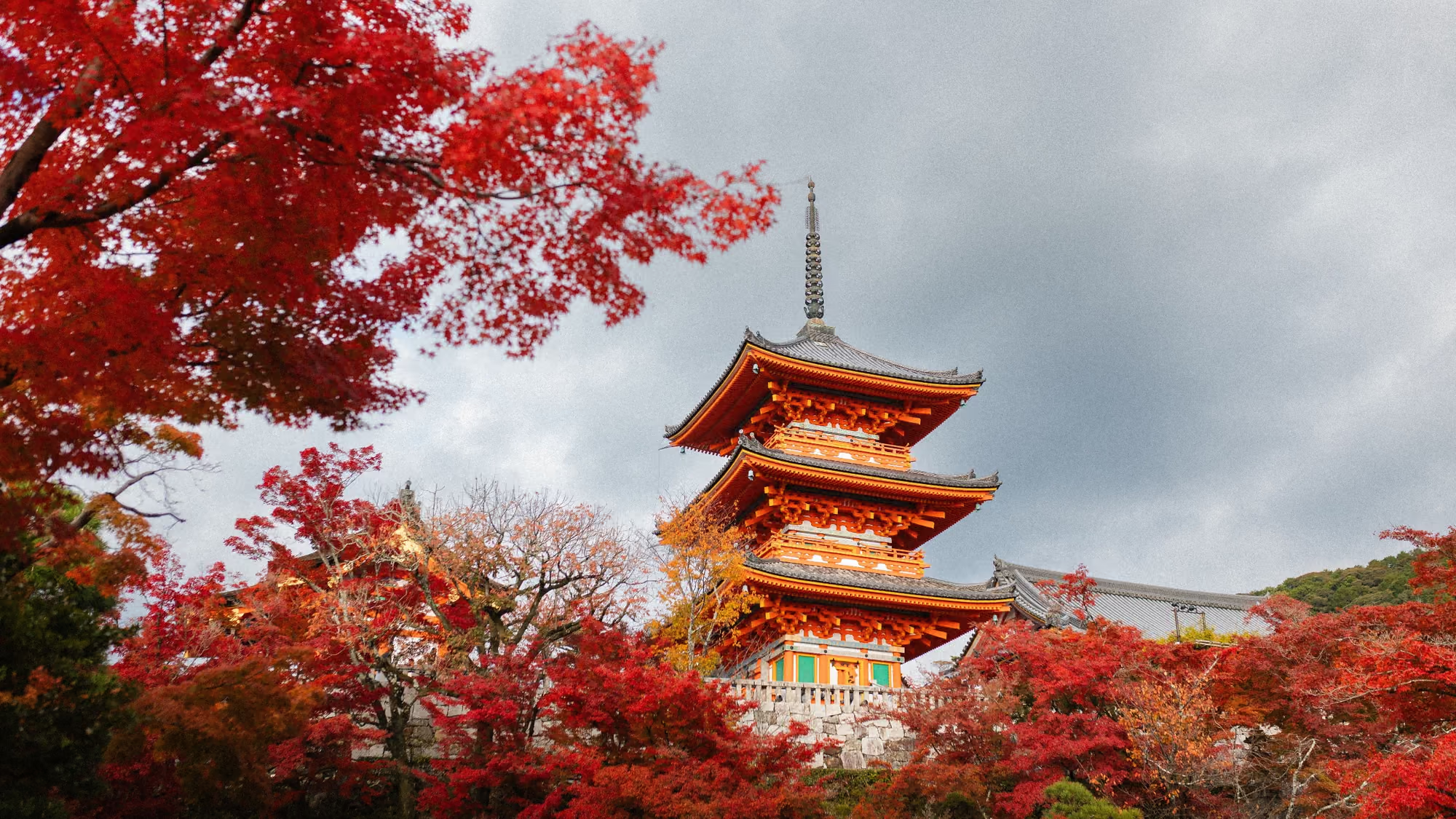
| Kyoto, Nara | late November–mid-December | Tofuku-ji, Eikan-do, Arashiyama, Kiyomizu-dera |
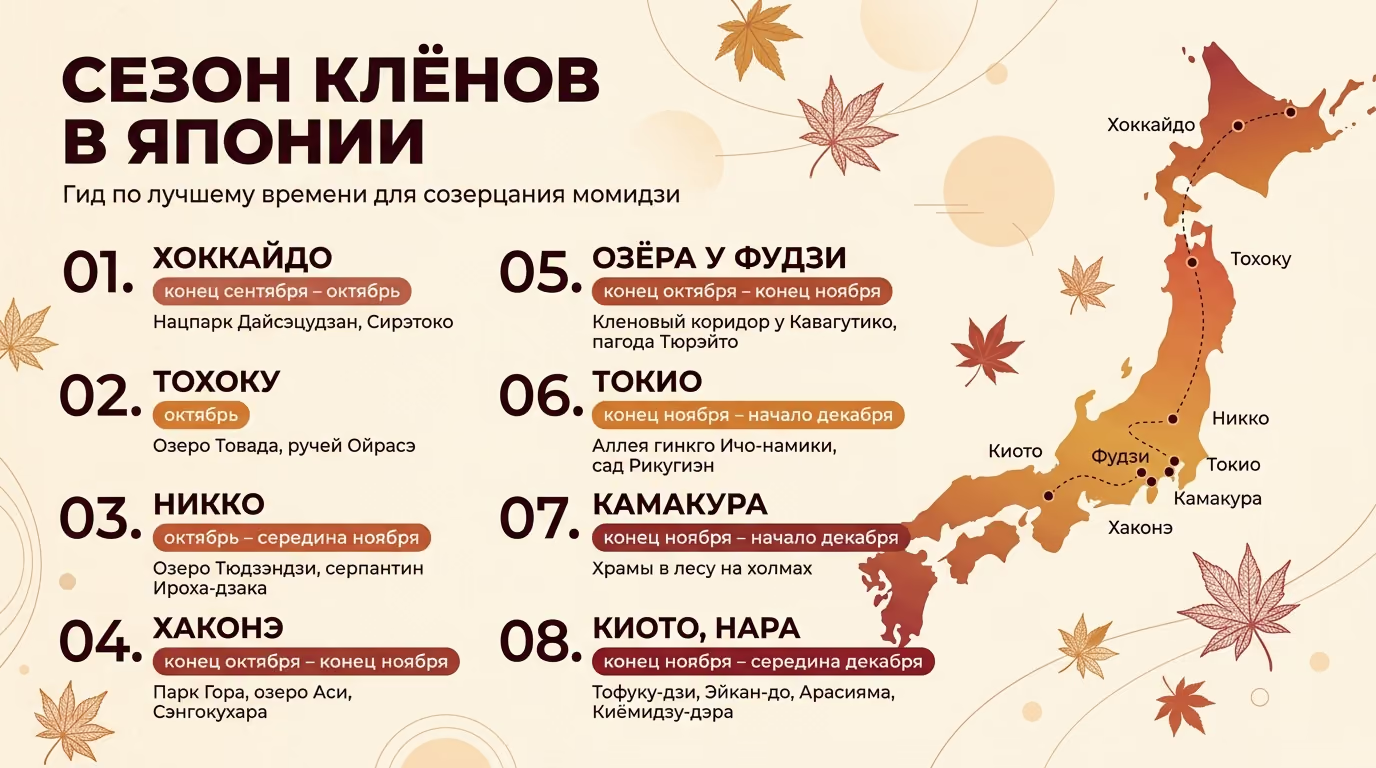
The dates are approximate, based on years of observation (Inside Japan Tours, nippon.com).
How to plan the route
Leaves turn when the nights get cold, so the mountains go red first and the lowlands follow. Hence a simple rule: mountains and lakes in the first half of the trip, cities in the second.
An example for 10–12 days in late November:
- Tokyo: the ginkgoes on Icho Namiki, Meiji Shrine, gardens lit up in the evening.
- Kamakura: temples in the hills, a day without the car.
- Hakone: Lake Ashi, an onsen, a view of Mount Fuji if the sky is clear.
- The Fuji Five Lakes: the maple corridor at Kawaguchiko and Chureito Pagoda at sunrise.
- The Japanese Alps: Matsumoto, Takayama, Shirakawa-go. The leaves may already be down here, but you might catch the first snow.
- Kyoto and Nara: the grand finale of the season, maples around the temples.
We chose this season for a few reasons. There are fewer tourists than in spring during the cherry blossoms, which means more affordable accommodation and flights. The main thing is to avoid the festival in Kyoto, so we planned the route to arrive in Kyoto on a weekday. And in my opinion the red maple season is every bit as rewarding as the cherry blossoms.
How to avoid the crowds
- Sunrise. We set out for Fushimi Inari and the Arashiyama bamboo grove before 8 a.m.
- Weekdays. On weekends the Japanese themselves head to Kyoto. That's why we go on weekdays.
- Evening illuminations. Many temples and gardens stay open in the evenings during the season, and nearby places are quieter during the day.
- Lesser-known temples. Instead of Kyoto's biggest names we drive around the surrounding area — the foliage is exactly the same.
- Book accommodation early. The two peak weeks in Kyoto are the most expensive of the year, and hotels sell out months ahead.
Weather and what to pack
In late November Tokyo and Kyoto are around +15…17 °C during the day and +7…10 °C at night; the mountains are colder and can drop below zero. Bring layers, a warm jacket for the evening and comfortable shoes: temples have plenty of stairs, and 398 steps lead up to Chureito Pagoda.
Visas
Citizens of Germany and other EU countries can visit Japan visa-free for up to 90 days. Citizens of Ukraine and Russia need a visa, and processing takes time, so apply well in advance. Check the requirements on the Japanese embassy website. The application itself is very straightforward, though. It's easily the most welcoming and pleasant consulate I've ever dealt with.
FAQ
October or November? October for Hokkaido and the mountains, late November for Tokyo, Hakone and the Fuji lakes, early to mid-December for Kyoto in 2026.
Can you combine Mount Fuji and the maples? Yes — the skies around the Fuji lakes are usually clearer in November, and the maple corridor at Kawaguchiko is right at its peak.
How many days do you need? At least 10–12 to see both the mountains and the cities without rushing.
How do you get around? Metro and trains in the cities; between the mountains and lakes a car is easier, since public transport there is poor.
Come see the momiji with us
Our road trip "Japan in Red Maple Season" on November 18–29, 2026 is almost full. The next group is for autumn 2027: write to us and we'll add you to the waiting list with priority for places. Tour programme.